Stratego Rules and Strategy: How to Play
Stratego is a two-player strategy game played on a 10×10 board. Each player starts with 40 pieces whose identities are hidden from the opponent. The first player to capture the other player’s Flag wins.
Quick rules at a glance
| Rule | Stratego Original |
|---|---|
| Players | 2 |
| Recommended age | 8 and up for Stratego Original US |
| Playing time | About 45 minutes for Stratego Original US; close games can take longer |
| Objective | Capture the opposing Flag |
| Board | 10 × 10, with two impassable lakes |
| Pieces | 40 per player, including 6 Bombs and 1 Flag |
| Common variants | Stratego Duel (10 pieces per side) and editions with optional Infiltrator or Battle Card rules |
This guide uses the 40-piece Original rules with the Marshal numbered 10. If you’re learning with the 10-piece Duel variant, its smaller army fits anywhere in the first three rows, leaving gaps. For age and play time, see the publisher’s edition listings.
Stratego piece ranks and what they do
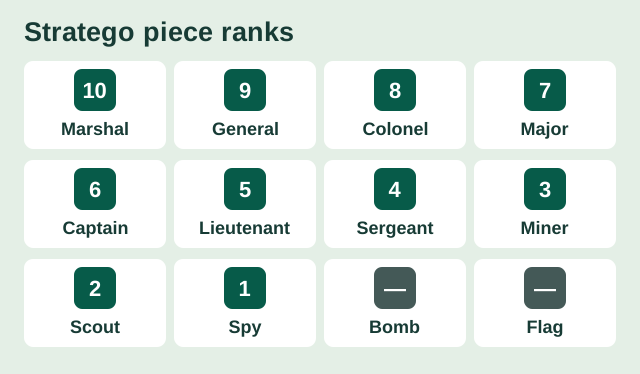
The higher number wins normal combat. Two exceptions change which fights are worth taking: a Spy can capture a Marshal by attacking first, and a Miner can remove a Bomb. Bombs and Flags have no numerical rank.
| Rank | Piece | Count | What it does |
|---|---|---|---|
| 10 | Marshal | 1 | Highest rank. Still loses to a Bomb or a Spy that attacks first. |
| 9 | General | 1 | Beats ranks 1–8 in normal combat. Can challenge the other General in an equal trade. |
| 8 | Colonel | 2 | Beats ranks 1–7. Useful for taking ground without revealing your top ranks. |
| 7 | Major | 3 | Beats ranks 1–6. A good follow-up after a Scout finds a weaker defender. |
| 6 | Captain | 4 | Beats ranks 1–5. Strong enough to threaten several kinds of support pieces. |
| 5 | Lieutenant | 4 | Beats ranks 1–4. Can cover an approach without committing a top rank. |
| 4 | Sergeant | 4 | Beats Miners, Scouts, and the Spy. Useful for guarding a lane. |
| 3 | Miner | 5 | The only piece that can remove an enemy Bomb and survive. |
| 2 | Scout | 8 | Can move or attack along a clear straight line across several squares. |
| 1 | Spy | 1 | Captures the Marshal only when the Spy makes the attack. |
| — | Bomb | 6 | Cannot move. Removes any attacker except a Miner. |
| — | Flag | 1 | Cannot move. Any movable enemy piece that attacks it wins the game. |
How to set up Stratego in five steps
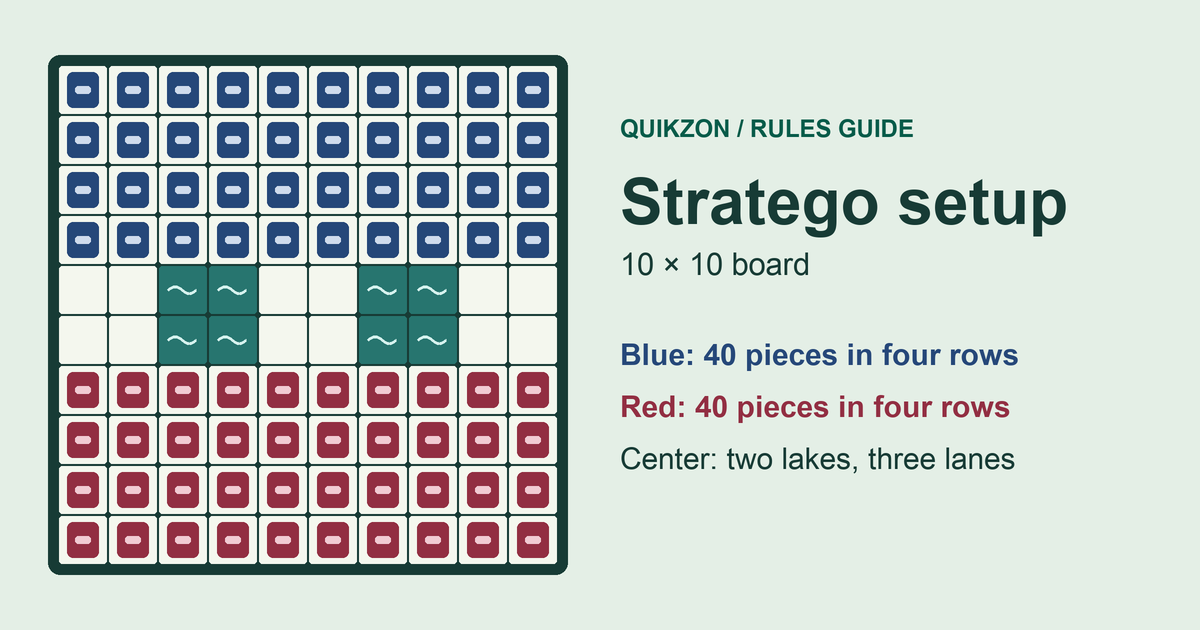
- Claim your starting rows. Sit on opposite sides of the board and take one color each. Each player freely arranges all 40 pieces in the four rows nearest them, one per square. Leave the two middle rows free of pieces; the lakes are already blocked. Use the setup screen if your edition includes one.
- Choose a Flag square. A back corner reduces the directions from which your Flag can be approached, but it’s also an obvious place to look. A spot farther from the edge can be harder to guess. Look at the squares next to it and decide which route you can defend once the board opens up.
- Place Bombs with an exit in mind. Protect one or more approaches to the Flag, but leave your mobile pieces a way out. A Bomb on the front line stays there, even if it later blocks the shortest route for your own General. Keep enough mobile pieces near each lane to respond if a Miner gets through.
- Put a few Scouts up front. Give them a path into the open middle rows so they can test an unknown defender early. Spread them between lanes. Keep at least one Scout behind the front so you can use its range later, after pieces move out of the way.
- Check the faces, then start. Turn the numbered side of each piece toward you so your opponent sees only its back. Take down the screen after both players finish. Red goes first in Stratego Original. Before making that first move, check that you have an opening on more than one side.
How to play Stratego: turns, attacks, and winning
Move one piece or make one attack
On your turn, move one movable piece to an empty square or attack an enemy. Most pieces go one square forward, backward, left, or right. Diagonal moves and attacks are illegal. A piece cannot enter a lake, share a square with a friendly piece, or jump another piece. You cannot pass. Your Bombs and Flag stay where you placed them.
The Scout can travel farther in a single direction along an open row or column. It can attack as part of that same move if an enemy is at the end of its clear path. For example, if two empty squares separate your Scout from an enemy in the same row, it can attack across both spaces. If either space is a lake or occupied, that attack is blocked.
The two-square rule prevents a piece from shuttling indefinitely between the same pair of squares. Check your edition’s wording for repeated moves and chases before settling a close finish.
Reveal both pieces in a battle
Declare the attack before seeing the defender’s rank. Both players show the pieces involved so they can resolve the result. If the attacker wins, it takes the defender’s square. If the defender wins, it stays put and the attacker leaves the board. Equal numbered ranks remove both pieces, so both squares end up empty. Turn any survivor back to its hidden orientation afterward; your opponent can remember what it was.
A Captain attacking a Sergeant takes the square, but a Captain attacking a Bomb is lost. Send a Miner instead and the Bomb comes off the board, with the Miner taking its square. The Spy’s special attack on the Marshal works only when the Spy starts the fight. A Marshal that attacks the Spy wins.
Know when the match is over
Capturing the opposing Flag ends the game immediately. You also win if your opponent has no legal move when it is their turn. A player left with only Bombs and a Flag has no move, even if the Flag itself is still safe.
For a casual draw, both players can agree to stop if neither can make progress. For instance, both might still have movable pieces, but each Flag is sealed behind Bombs and neither side has a Miner. If one player can still force the other out of legal moves, there may be a winner. Repetition and clock procedures vary, so use the event or app rules if you’re playing a timed or competitive game.
For edition details, see the Stratego Original rulebook and the International Stratego Federation tournament rules.
Stratego strategy: six tips from opening to endgame
- Use an opening decoy you can afford to lose. Put a spare Scout or Sergeant near an exposed lane and keep a stronger piece close enough to reply. If your opponent takes the bait and shows a rank you can beat, you can trade a weaker piece for a stronger one. If it turns out to be the Marshal, you’ve learned where to avoid committing your General.
- Keep a reserve of Miners. Position them behind pieces that can handle early fights and leave separate routes for them. A Miner that clears one Bomb and is immediately captured may leave the real Flag unreachable. As your other pieces push forward, keep track of which lanes a surviving Miner could use to reach the back row.
- Save the Spy for the middle game. Keep it out of open scouting lanes until you have located the enemy Marshal. A Spy near your General can make the enemy Marshal think twice about taking the General. For that threat to work, the Spy must be able to reach the General’s square after the attack.
- Scout an open lane with a follow-up in mind. With a Captain ready to advance, send a Scout down the lane to test the piece blocking it. If you reveal a Sergeant, the Captain can threaten it on the next turn. If you reveal a Colonel, change routes. A long move identifies your Scout, so use it when the information will change your next decision.
- Let Bombs create doubt. An untouched piece could be a Bomb, a valuable rank, or a spare piece that hasn’t had a reason to move. Putting a Bomb away from the Flag can make a harmless corner look important. Meanwhile, any piece you’ve moved has given away that it’s neither a Bomb nor the Flag. Keep track of that distinction on both sides.
- Clear the Bomb that opens the best route. In the endgame, mark where the opponent’s remaining pieces have moved and where Bombs have already been revealed. Before sending in a Miner, check which enemy piece could capture it after it takes the Bomb’s square. Use a stronger escort to drive that piece away, then spend your Miner’s turn on an opening that leads toward the likely Flag.
Frequently asked questions
Can the Spy capture the Marshal?
Yes, if the Spy initiates the attack on the Marshal. If the Marshal attacks first, the Spy is removed instead.
Can a Bomb move?
No. A Bomb stays on its starting square until an enemy Miner attacks and removes it. A different attacker is removed and the Bomb stays on the board.
Can the Flag be moved?
No. Your Flag stays wherever you put it during setup, and the game ends as soon as an enemy piece captures it.
How far can a Scout move?
A Scout can move along a clear row or column as far as the board allows, up to nine squares in one turn. It can attack the first enemy in its path, but it cannot jump a piece or cross a lake.
How is Stratego different from Junqi?
Both games use hidden ranks and a flag, but Junqi, also called Chinese military chess, uses a network of marked routes and special spaces instead of Stratego’s square grid and lakes. Junqi has railway movement, so its long moves depend on the route as well as the piece.
Where to play Stratego
Visit the official Stratego site for the web version. For the official mobile edition, see Stratego Online on the App Store for iPhone and iPad or Google Play for Android. Check the selected mode before applying these tabletop rules to a digital Stratego game.